

You’re probably here because you’re thinking about building something with AI. Maybe it’s a smart app, a recommendation engine, or even a full-blown automation system. Sounds great. But then comes the real question.
Who’s going to build it?
Hiring AI developers isn’t like hiring general developers. It’s not just about coding skills. It’s about how they think, how they approach problems, and how well they can connect business goals with technical execution.
Pick the wrong team, and you’ll feel it fast. Delays. Confusion. Missed expectations.
Pick the right one, and things just click.
Let’s break down how you can actually do that.
Start With What You Really Need
Before you even look at resumes or agencies, take a step back.
What exactly are you trying to build?
Is it:
- A chatbot for customer support?
- A prediction model for sales?
- Image recognition?
- Process automation?
Each of these needs a different skill set.
You don’t need someone who “knows AI.” You need someone who knows your type of AI.
Be honest here. If your scope is unclear, even the best developer won’t save you.
Don’t Just Look for Coders
Here’s where many businesses slip.
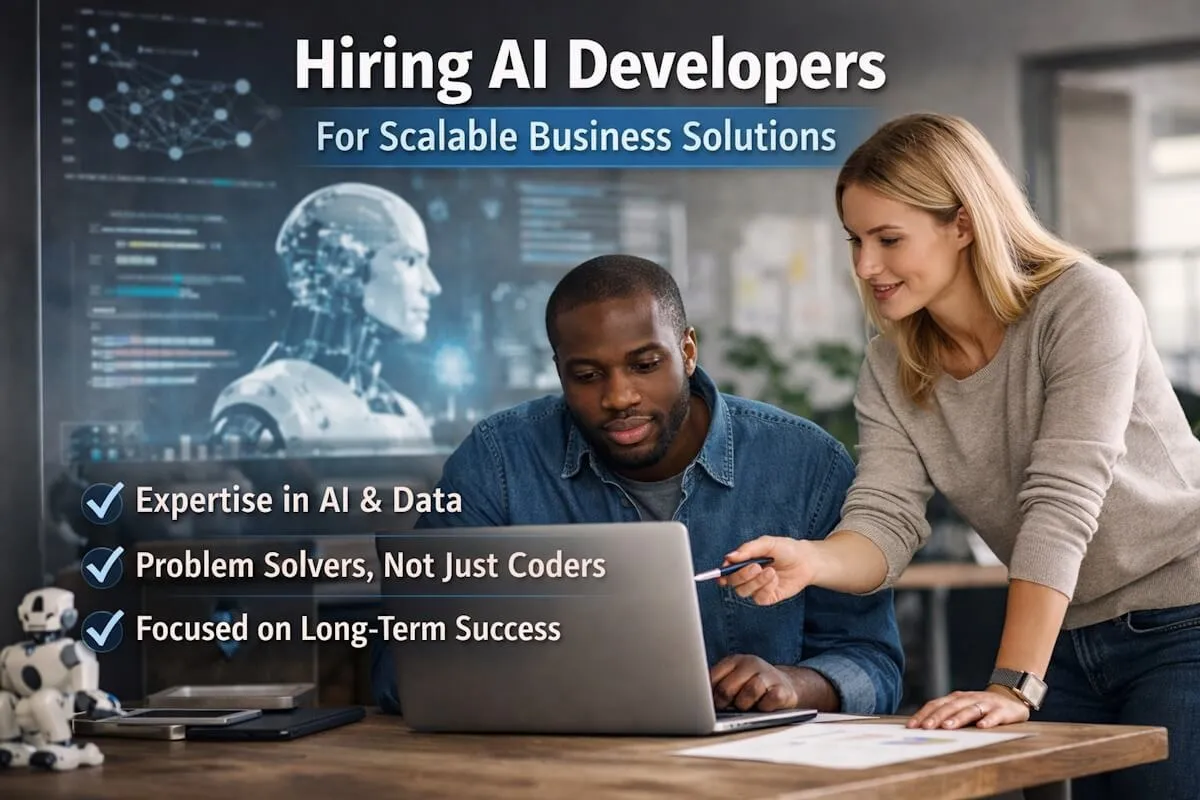
AI developers are not just coders. They are problem solvers.
They should:
- Understand data, not just code
- Ask questions about your business
- Suggest better approaches instead of blindly following instructions
If someone jumps straight into “we’ll build this using X model” without asking about your data or goals, that’s a red flag.
Good developers challenge your assumptions a bit. Not in an annoying way, but in a way that shows they care about the outcome.
Experience Matters, But Not How You Think
You might be tempted to hire someone with 10+ years of experience. Sounds safe, right?
Not always.
AI changes fast. What mattered 5 years ago might not matter now.
Instead of years, look for:
- Projects similar to yours
- Hands-on work with real data
- Ability to explain what they built and why
Ask them simple questions like:
“What was the hardest part of your last AI project?”
Their answer will tell you a lot.
Check How They Handle Data
AI without data is nothing.
Seriously.
So ask:
- How do you clean and prepare data?
- What if the data is incomplete?
- How do you deal with bias?
If they struggle to answer this, pause right there.
Strong developers don’t just build models. They understand messy, real-world data.
Communication Is a Big Deal
You don’t want to sit in meetings where everything sounds like a foreign language.
The right AI developer should:
- Explain things in plain English
- Keep you updated without you chasing them
- Be open about challenges
If they can’t explain their approach simply, things will get messy later.
Freelancers vs Agencies vs Dedicated Hiring
Now comes a practical choice.
Who should you hire?
Freelancers
Good for small tasks or experiments. Risky for long-term or complex projects.
Agencies
More structured. You get a team, not just one person. Better for scaling.
Dedicated Hiring
If you’re planning something long-term, this is where it gets interesting.
When you Hire AI Developers, you get focused attention. They work as an extension of your team, not just an external resource.
This setup gives you more control and better alignment with your goals.
Look Beyond the Resume
Resumes are polished. Real work is messy.
Ask for:
- Code samples
- GitHub profiles
- Case walkthroughs
Even better, give them a small paid task.
Not a huge one. Just enough to see:
- How they think
- How they communicate
- How they handle feedback
You’ll learn more in a week than from hours of interviews.
Scalability Should Be Part of the Conversation
You’re not building something just for today.
You want it to grow.
So ask:
- Can this solution handle more users later?
- What happens when data increases?
- How easy is it to update the model?
Developers who think long-term will talk about structure, not just features.
That’s what you want.
Don’t Ignore the Tech Stack
You don’t need to know every tool out there, but you should have a basic idea.
Common tools in AI projects:
- Python
- TensorFlow or PyTorch
- Cloud platforms like AWS or Google Cloud
What matters is not the tool itself, but why they chose it.
Ask:
“Why this stack?”
If they say “because it’s popular,” that’s not enough.
Time Zones and Availability Matter More Than You Think
If your developer is always asleep when you’re working, it slows things down.
You don’t need perfect overlap, but some shared working hours help a lot.
Also, check:
- Response time
- Meeting availability
- Willingness to adjust when needed
Small things, big impact.
Budget vs Value
Let’s be real.
AI development isn’t cheap.
If someone offers extremely low rates, there’s usually a catch:
- Limited experience
- Poor communication
- Shortcuts that hurt later
Instead of asking “how cheap can I get this done,” ask:
“What value am I getting for this cost?”
Sometimes paying a bit more upfront saves you a lot later.
Why Many Businesses Choose External AI Teams
Building an in-house AI team sounds great. But it’s not always practical.
You need:
- Data scientists
- ML engineers
- Backend developers
- Possibly DevOps
That’s a lot.
This is where AI Development Services come in.
You get:
- A ready team
- Proven processes
- Faster execution
It’s not about outsourcing blindly. It’s about working with people who have already done this before.
Ask About Post-Launch Support
Launching your AI solution is just step one.
What happens after?
- Will they monitor performance?
- Can they retrain models?
- Do they fix issues quickly?
AI systems need updates. They are not “set and forget.”
Make sure your developer stays around after launch.
Red Flags You Shouldn’t Ignore
Let’s keep this simple.
Walk away if you see:
- Overpromising timelines
- Vague answers
- No real project examples
- Poor communication early on
Trust your instincts here.
If something feels off now, it won’t get better later.
Build a Relationship, Not Just a Contract
This one gets overlooked.
You’re not just hiring someone to write code. You’re bringing in a partner.
When things go wrong, and they will at some point, you want someone who:
- Stays calm
- Works through the issue
- Keeps you informed
That only happens when there’s mutual trust.
So, What’s the Smart Move?
If you’ve made it this far, you already know this isn’t a quick decision.
Take your time.
Ask questions.
Test before committing.
And most importantly, stay involved. Even if you’re not technical, your input matters.
Because at the end of the day, it’s your business. Your product. Your risk.
And also your win.
Ready to Make the Right Hire?
You don’t need to rush this.
But you do need to get it right.
Think about your goals. Be clear on what you need. Talk to a few developers or teams. Compare not just skills, but how they think and communicate.
That’s where the real difference shows up.
And once you find the right fit, everything else becomes easier.